My best war story is one my college chum Aukamp told me, but that’s a second-hand source. Everything else is true, or as true as episodic memory[i], frayed by age, can contrive. So, I shall append Auk’s yarn as a coda to the following account.
In the timing of the series of conflicts which
defined the 20th century my generation was fortunate. When World War II ended on the 15th of August, 1945 I was thirteen, five years short of compulsory military service, and so deprived of the glorious opportunity to die for my country or whatever political administration might have been in charge at the time. Though it started rumbling ten years later, the Vietnam conflict did not substantially involve the United States until 1965. By then I was in my thirties, already a military veteran, married with three children, and so unlikely to be called on to sort things out in Saigon. In any case, I had already scarpered to Europe.
But, on the 25th of June, 1950, two weeks short of my eighteenth birthday, and one week after I graduated from high school (La Salle Military Academy), President Harry Truman declared a ‘police action’ against North Korea. My generation was squarely in the frame. The draft was reimposed and a million and a half men aged 18+ were hoovered up into military service. However, there was a get-out clause: anyone bright enough and sufficiently resourced to continue with further education was exempt for the duration of his studies. Most of my class were destined to go to college; this undemocratic loophole provided extra incentive.[ii]
Fast forward four years: the compulsory military service, the draft, is still on. An armistice had been agreed on the 27th of July 1953, but no peace treaty has yet been signed. So technically, we are still at war.[iii] After I graduate from Hobart College in Geneva, New York in June, 1954, I’m called up for a medical examination in Manhattan. There’s a fleeting moment of hope: the doctor frowns and sucks in his breath while examining the eczema scars on my inner elbow. But I don’t have the influential medical connections later available to two presidents, George Bush and Donald Trump. The doc passes me and in September I tumble into eight weeks of army basic training at Fort Dix, New Jersey.
The psychological strategy underlying this indoctrination is to crush any spirit of independence and then reconstruct the recruit as a biddable automaton. I was issued uniforms, had my hair crew-cut, received a battery of inoculations and an advance on my $50 monthly salary – a twenty-dollar bill called a ‘flying twenty’ because it didn’t stay long in athe recruit’s pocket. A rotten molar I had neglected was yanked out without negotiation, and I joined a muster in front of the barracks of the first platoon of Easy Company. I was feverish. A weird lanky figure, a staff sergeant, was stalking up and down the ranks haranguing us. (I forget his name, let’s call him Sgt. Hillbilly.) He was laying down the rules. When he got on to how to report to sick bay I thrust up my hand: “Reporting to sick bay.” He was aghast, and flew up to me shouting and ranting, his mouth gaping inches from my face. Too fevered to care, I just stood my ground and, I don’t remember how, ended up in hospital.
My fever turned out to be a reaction to one of the injections. Two days later I reported back to barracks. Sgt. Hillbilly greeted me at the door with another frenzied outburst, his long arms and legs flailing about, lumpy fists threatening my nose. Spittle frothed from his mouth. Still a bit groggy from my hospital internment, I stood in dull amazement. I almost laughed. Which might have been fatal. “Yes, Sir” I replied to one of the sergeant’s curses, seeking to flatter him. This ignited a renewed paroxysm. “You say ‘Yes, Sergeant, mothafukkah.’” “Yes, Sergeant”, I said, but left off the mothafukkah.
Behind him my fellow recruits, standing stiffly to attention by their two-tier bunk beds, were clearly terror-stricken. But I had missed the first two days of their ritual humiliation, and so I was always faintly amused rather than terrified by Sgt. Hillbilly. At some level he must have sensed this, and that earned me his grudging respect. He never singled me out for assault again, and thanks to my four years of military training in La Salle Military Academy I was proficient at marching and rifle drill. He appointed me to carry the company’s guidon, which meant I set the pace on our marches. Although I was frequently ordered to “Stretch those legs, Anderson”, this meant I could stride out steadily at the front rather than at the rear, where dust-covered stragglers trotted to keep up as the column stretched and collapsed behind me like an accordion.
We were rostered alphabetically, so my bunk was the first on the right inside the door. I was on the lower level; the one above me was occupied by a bloke called Abramson. Which was a problem, because Abramson was psychotic. My first night in barracks he peed his bed. I demanded we switch bunks, regardless of what Sgt. Hillbilly had decreed, and we did so without him taking notice. Abramson, who, pale and vacant-eyed, looked like Andy Warhol, was a continual nuisance in training. When we began rifle practice with live rounds Abramson filled his gun barrel with sand, which qualified him for Section 8: immediate dismissal from the armed forces on the grounds of insanity. Maybe he was Andy Warhol?
The training experience desensitised, aiming to destroy any sense of identity and personal agency. One of the first things we learned was how to defecate in public. The latrine at the end of the barracks had no toilet cubicles, presumably to discourage homosexual activities. So, you sat and did your business in company; after the first couple of sessions you lose any sense of embarrassment. There was bayonet drill, where we were commanded to howl war hoops while charging to thrust the blade on the rifle into a suspended stuffed bag. If you didn’t shout vigorously enough you have to do it again and again, until finally an exhilarating blood lust overwhelms you. You become a beast and you get some deranged pleasure out pretending to disembowel another human being.
The days were long and hard and I became very fit. If you looked at a sergeant cross-eyed (and I had strabismus) he would order you to “Give me twenty.” That meant twenty push-ups, and he would stand over you counting them off. Once, powered by anger and resentment, I perversely forced one tormentor to count up to forty-two before I collapsed. At intervals we stopped marching and were told to “Take five.” I acquired the ability to lie down anywhere and fall asleep instantly, a talent which I maintained into later life, though nowadays my naps last not five minutes but an hour.
One night we spent in two-man foxholes. We stared into a marvellous thundering display of arching incendiary rounds erupting from the blackness. These were live bullets aimed at us by another company of recruits. They were fired from machine guns mounted on wooden tripods so that the barrels could not be depressed beneath knee height. We were told that the unseen ‘enemy’ company was crawling towards us under the line of fire. My companion was an amiable guy called, I think, De Lucca. We had a machine gun, too, and retaliated with our own bursts of tracer fire, sending flaming dash lines of arcing into the night. It was exhilarating. We both wanted to be the man on the trigger, rather than the one feeding in the belt of bullets. In the lulls between these displays, staring into the blackness as the hours crept by, we both got spooked. The amiable De Lucca became trigger happy and I had to restrain him from wrenching at the tripod to depress the line of fire so that we could actually hit the ‘enemy’, i.e. the guys in the other company.
On another exercise, on a freezing night, De Lucca and I shared a two-man pup tent warmed only by the flame of a fist-sized can of ‘Sterno’ alcohol fuel gel. At dawn there was an air raid. A light plane circled above our camp with a guy leaning out dropping sacks of flour. If you were stained with flour you were deemed ‘dead’. I couldn’t stop laughing and pointing up at this surreal absurdity. Until a sack of flour landed on my helmet and turned me into a snowman.
De Lucca was a drummer and on formal parades kept our company marching in step. One evening all the training battalions were mustered to attend a football game. I marched at the very end with a massed group of guidon bearers while De Lucca was in the rank in front of me, beating with the drummers. We had concocted a scheme and contrived to be on the outer edge of the rank. As the parade swept passed the PX (Post Exchange), where there was a bar, we dropped off the end of the parade, stowed the guidon and the drum behind some bushes and popped in for a drink. A couple of hours later, as we heard the drums approaching we slunk out and rejoined the tail of the parade. But the gassy, low-alcohol beers had their effect. De Lucca wanted to carry the guidon, and I fancied the opportunity to play a drum. Until scowls and grumbles from my fellow drummers forced me to desist and just wave the sticks about. Still it was a small act of rebellion, and better than watching a football game in the cold.
Towards the end of our eight-week basic training the entire battalion of around 400 men was marched into a cinema. We were to be interviewed for assignment to different units of the army for further training. The few ‘regular army’ recruits amongst us, men who had volunteered for a three-year term of service, could choose a vocation; we draftees, who had to serve two years, would be mandated. The sergeant on stage announced the number of places available: several hundred infantrymen and artillerymen were needed, dozens of medics and catering corps and so on and – oh yes – two signal corps photographers. When my turn at the interview desk came I asked to become one of them.
“Any experience?” asked the interviewer.
Well, I reckoned I could learn as fast as any regular army recruit and so I improvised: “Just a few months as an apprentice staff photographer for Newsday.”
The interviewer raised an eyebrow: “You worked for the New York Daily News?”
I thought it prudent not to overclaim. “No. Newsday, the Long Island daily newspaper.”
We would find out later where we would be assigned, but in the interim, I was summoned for an individual interview for the Counter Intelligence Corps (CIC) on the basis of my score in the Scholastic Aptitude Test (SAT), a universal college entrance examination. The CIC was a World War II and early Cold War intelligence agency within the army consisting of highly trained special agents, and rumoured to be a recruitment ground for the Central Intelligence Agency (CIA). I was required to fill out a lengthy form which included all the addresses I had ever lived at and all the schools I had attended. There were more than a dozen of each and the interviewer zeroed in on this.
“Why did you move so much?”
The interviewer wore civilian clothes and that disarmed me. Apparently released from the oppressive bullying I had endured for the past several weeks and irritated by his plodding examination, I was flippant.
“You’d have to ask my Dad”, I said.
But, of course, he was a military officer in civilian clothes and the CIC probably did not prize petulance in its recruits. And so I lost my chance to become a surrogate Felix Leiter, the American CIA agent whom Ian Fleming had just created as a foil to James Bond. Which was probably no bad thing as Leiter lost a leg and a hand in a shark attack before eventually being killed off. And if honest aggravation was my downfall, duplicity was rewarded: I was one of the two chosen to undergo comprehensive Signal Corps photography training at nearby Fort Monmouth, New Jersey.
Over sixteen weeks we were taught everything there was to know about the current state of the art. This was based on the Speed Graphic, the bulky camera equipped with flash bulbs which you see wielded by clusters of news photographers besieging celebrities in old black-and-white movies. The primary benefit of this camera is detailed reproduction; it preserves images on a large 4 by 5 inch
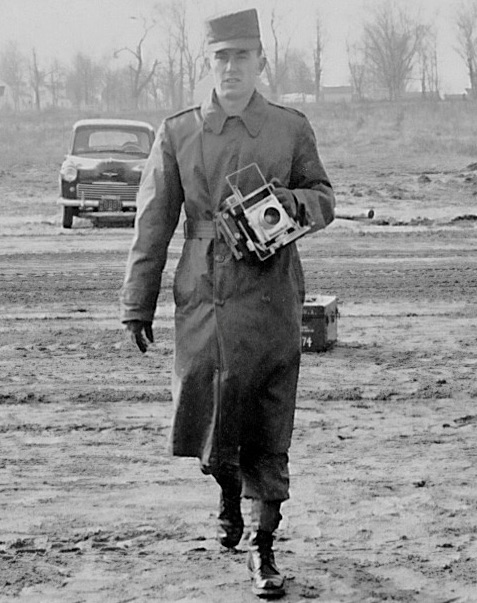
negative. But you have to remember to remove the slide shielding the negative for each shot, then replace it, then reverse and re-insert the slide holder to prepare for the next shot. And each flash bulb fires only once, and has to be replaced as well. And the camera and all the associated gear, pre-loaded slides, flashbulbs, tripod, etc. were transported in a heavy case. One of the most important things to remember was to keep the two clips on the case fastened, so that if you came under enemy fire the contents wouldn’t spill out on the ground as you grasped the handle to leg it.
I made some good friends in photography school: a handsome guy of Irish descent from Boston who had the name of the favourite gin tipple of my aunts and uncles: Tom Collins; David Jacobs, a sweet-natured professional violinist who volunteered to replace me on KP (Kitchen Police) duty so that I could spend my first Christmas Day with my new wife in the apartment where I lived off-base; and a guy called Giuliani, whose first name I forget. One weekend somehow Giuliani and I acquired tickets to a Penn State football match and weekend passes. We took the train on my one and only visit to Philadelphia. We were in uniform of course, and as we ambled down a steep street leading to the stadium we approached a bloke leaning over a fenced front yard. He gave us a mock sneer and muttered ‘Dogfaces’. I recognised the curled upper lip. Dick Brennan, a cheeky chappie, had been my roommate in my first year at La Salle. Now, eight years later, he was standing in front of his fraternity house. He had been a dogface himself and was now a graduate business school student. We were soon in the frat house assaulting a barrel of beer left over from the night before. Giuliani was immensely impressed with my social connections in Philadelphia.
The high point of the photography course, in both senses, was a flight in a two-seater Piper Cub aircraft. In the air the pilot chose a building and dipped the nose of the plane into a stomach-churning nose-dive. As the building rushed up at us, my assignment was to lean out of the cockpit clutching the cumbersome Speed Graphic and at that moment of zero gravity when he pulled up out of the dive, snap the building. Don’t forget to pull the slide and don’t let the Speed Graphic drop!
Completion of the photography course earned me an MOS (Military Occupational Speciality) as a Signal Corps photographer. This was important. It meant that you could not just be chucked into the infantry or any-old-where. You had to be assigned to a job which would make use of your valuable training.
“The guy you’re replacing lasted one month. He was a prisoner. He stood here with an armed guard behind him.”
I hoped to be sent abroad, to Germany perhaps. I was sent a few hundred yards to a transit barracks. That’s where soldiers go while waiting for their orders to be ‘cut’. It’s purgatory. You don’t know how long you’re going to be there and the army doesn’t know what to do with you. We assembled early each morning, everyone jostling to stay in the middle of the ranks because the sergeant in charge would peel men off from either end, assigning them to meaningless tasks. Those not chosen at assembly were released to return to the barracks, where they hid all day from foraging taskmasters. One day I was sent to mow the lawn on a major’s residence. I was issued with a dull bayonet, which could sever a grass stem if you stretched it taut with one hand and sawed at it with the other. I spent the day kneeling on the major’s lawn engaged in this process.
Which brings to mind another Aukamp story. He preceded me into the army by a few weeks and spent some time working in a Personnel section. The captain in charge insisted that every desk had to be clear at 5.00pm each Friday. And so they were. Because Aukamp and his colleagues would bundle up any not yet processed transfer orders and post them somewhere – Alaska Command, for example. These paper pigeons would flock home eventually, while the personnel in question languished another week or so in the transit barracks.
I spent only a few days skulking in transit barracks before receiving orders to move across the breadth of the United States to Fort Lewis, the headquarters of the Sixth Army, near Tacoma, Washington. It was the shipping-out point for Korea.
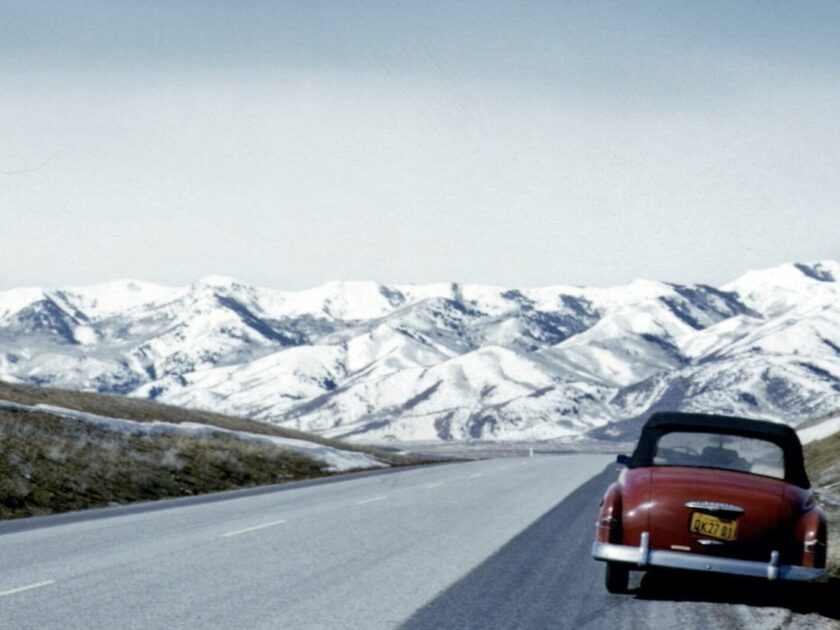
As a married man I would be able to live off-post. I traded in my 1949 Ford, and my wife, Barbie, and I drove across the country in a snazzy red 1952 Plymouth convertible. We rented a damp and gloomy bungalow in a patch of forest on the perimeter of
Lakewood, a Tacoma suburb. I reported to the Personnelsection at Fort Lewis, eager to discover what photographic assignment the army had sent me 3,000 miles to perform. Personnel sent me to a printing shop. It was staffed by civilians. One of them placed me in front of a machine like a large box with a hinged lid. It was an Ozalid, a device for copying large drawings. My job was to pick up an architectural drawing, marry it with a sheet of special copier paper, insert the two into the machine, press a button, then stand waiting a minute or so while the machine rumbled, before extracting the result and separating the sheets into two piles. Then repeat.
“That’s my job?” I asked.
“You’ll soon get the hang of it,” my civilian boss replied, not suppressing a smirk.
“I have eighteen months left to serve”.
The civilian chortled. “The guy you’re replacing lasted one month. He was a prisoner. He stood here with an armed guard behind him.”
“What happened to him?”
“He threw his cap into the Ozalid and broke it. So, they sent him back to the stockade.”
At lunchtime I put my cap on my head and went back to the sergeant at Personnel.
“You can’t send me there. I’ve got an MOS as a photographer,” I said.
The sergeant shrugged. “The Ozalid is a photographic process.”
But he was not an unkind man. I must have told him about the prisoner. Somehow I talked him round and he pulled some strings and within a day or two I joined the staff at the Photo Lab on the base. Almost immediately I was involved in a major Sixth Army military exercise which sprawled across the arid plains of eastern Washington for a week or so. Jolting across the Cascade mountains in the back of an open jeep in freezing temperatures, despite wearing long johns under my combat jacket and fatigues, I was shivering. This attracted the scorn of the lieutenant seated in front. He was a ruddy, thick-set yokel from the rural South. I forget his name – probably for deep psychological reasons – but he will reappear in this narrative, so let’s call him Lt. Redneck.
It turned out he was in charge of the photo unit assembled for the manoeuvres, and I did my best to stay out of his view. So did everyone. A group of twenty or so photographers, we loitered in a barracks in stifling desert heat. Blankets were hung over the windows, keeping it in perpetual gloom. Occasionally the door would creak open, sending in a shaft of light and someone would be summoned for an assignment. Otherwise, we emerged only three times a day to go to the mess tent. For entertainment a film projector ran almost continuously, projecting a movie on to a screen at the end of the room. There was only one film. I spent most of the week lying in a bunk, opening an eye occasionally to glimpse a bleary scene from The Creature from the Black Lagoon.
Back at Fort Lewis the Photo Lab housed a congenial group of GIs plus a couple of civilians. I progressed rapidly, at first developing negatives in a black, airless chemical-laden cupboard, then making prints in a darkroom equipped with chemical trays and enlargers, and was soon elevated to staff photographer. I could go outdoors! I could come and go as I pleased, a free agent, totally unsupervised, roaming the base on assignments, usually with transport laid on. This often involved mixing with elevated officer ranks, snapping generals awarding medals in circumstances where I could cadge a cup of coffee, a couple of doughnuts or a sandwich.
I was given a dream assignment: covering the Reserve Officers Training Corps summer camp. The ROTC was the government’s military training programme in colleges. I had been in the Air Force arm of the ROTC myself, with the rank of Lt. Colonel, commanding the branch at Hobart College in Geneva, New York. Until, in a similar summer training camp, they discovered I was faking the eye tests and discharged me. Now, photographing my former peers anointed to become real officers, I was still a buck private, the lowest of the low in the army.[iv] I spent a sybaritic few weeks being ferried around the hinterland in a jeep to record these college boys grinding through war games in the gruelling heat.
“You can park in the shade of this tree, Sergeant,” I would say to my driver. “I’ll be back in a few hours.”
I could leave my heavy box with most of the photographic kit in the jeep, just toting a supply of pre-loaded slides, and an opaque black bag provided with sleeves which enabled me to load negatives into slides without exposing them to daylight, for use in my Speed Graphic camera. We were of course aware of handy, lightweight 35mm still cameras which produced good reproduction from roll film and some of the photographers used them informally, yet the US Signal Corps persisted in using this bulky, cumbersome contraption.[v]
The good life continued at the Photo Lab. The two or three civilians and we GIs worked companionably under a benevolent administration. Everyone had a side hustle. We made portraits and printed photos for family and friends, including of
course that helpful sergeant in Personnel. Barbie and I took weekend excursions through the magnificent mountain and desert scenery of the state of Washington and I sold several photographs to the Tacoma News Tribune, the main daily newspaper in the region, which were used as full-page covers for their Sunday supplement. Once, when the Photo Lab had just received a tip-off about
an imminent ‘surprise’ inspection[vi] by headquarters, and we were rushing about trying to get everything in order I remember a civilian employee hovering by the print drying machine, white-faced. Print-drying was a slow process. You slowly fed photographs between the large rollers of this device, and waited to peel them off as they emerged ten or fifteen minutes later. The civilian’s prints started to drop off the drum, one by one: they were crude pornographic Christmas cards.
It was not all a bowl of cherries. About once a month my name would come up on the KP (Kitchen Police) roster. This meant reporting for duty at the mess hall well before dawn for hard labour for 15 or 16 hours, commanded at the whim of the cooks. These were a cabal of regular army black guys, sergeants mostly, who spoke their own patois, bantered companionably with each other all day, and took a malicious delight in shouting orders at their slaves. I don’t know whether they were dealing retribution to whitey or if it was just their general weltausblick, but the humiliation was unremitting. There was much to learn: how to wield a mop, and how to wash the glasses in the basin of scalding soapy water first, then the cutlery, the cups, the dishes and finally the greasy pots and pans.
The treasured job, which I never drew, was Outside Man. The downside was that this man hovered outside the back door by the garbage bins in the rain and the cold all day; but it meant he was spared a lot of the harassment. Occasionally, one of the cooks would shout ‘Outside Man’ and he would have to dash inside to collect a bucket of slop, but often they would forget about him. The worst task was to be sent outside to clean the grease trap. For some reason this was not within the remit of Outside Man, who would watch while you did it. The grease trap lay within a sewer and collected all the fats from the kitchen sinks. When you lifted the manhole cover the stench would knock you back. It was impossible to clean the grease trap without first vomiting into it.
Around 9.00 pm on the 9th of February, 1956 I drove straight from KP duties to the Fort Lewis hospital. Barbie introduced me to our wonderful infant daughter, a living doll with sealed eyelids and tiny clenched fists. I lay down beside my little family, hoisting my boots off the bedclothes, and fell asleep.
And then in the early spring of 1956 – disaster!
[i]Episodic memory, which resides in the hippocampus, registers personal experiences garlanded with vivid sensory impressions – as opposed to semantic memory, which is retained in the frontal cortex and is about facts you can look up on Google, such as these. See Charan Ranganath, Why We Remember: The Science of Memory and How it Shapes Us (Faber & Faber, 2024)
[ii] I heard of only one student from my elite military academy who served in Korea. Robert Van Allen, who had dropped out of school, never came back.
[iii] So I qualified as a Korean War veteran. This entitled me to tuition and subsistence grants for further education under the GI Bill of Rights, which I took advantage of after my military service to pursue a master’s degree at Syracuse University. An MSc in television, would you believe? While the GI Bill expired in 1956, to this day the Korean conflict has never been officially terminated.
[iv]Normally one was routinely elevated to Private First Class after nine to twelve months in the army, which put a few more dollars into your pocket, but my advancement didn’t come through until a few months before I completed my service. Possibly my file was marinating on a desk in a Personnel section headed by a tidy-minded officer like the one who presided over Aukamp’s unit?
[v] AI explains that the Speed Graphic (military designation PH-47) was the standard issue camera for U.S. Army photographers during World War II and continued as a workhorse during the Korean War. The American government, deprived of access during the Second World War to high-quality German 35mm still cameras such as Leica, was unable to develop a mass-produced alternative, the Kardon, until war ended, when the contract was promptly cancelled. But by my time of service ten years had elapsed; the only explanation can be bureaucratic paralysis.
[vi] Inspections were never a surprise; the entire establishment was riddled with moles. When spontaneous inspections were ordered someone would always pick up the phone and let you know an hour or so in advance. I once saw a squad of soldiers furiously loading into jeeps the regulation white-washed boulders the size of cannonballs which lined the driveway of a building the inspection party had just left. The stones were to be conveyed to the next-but-one unit about to be inspected to be exchanged for others where the whitewash had been neglected.