And then in the early spring of 1956 – disaster! Lt. Redneck swaggered into the Photo Lab. He was now in charge. He was immediately on my case, instructing me to turn in my camera. Before the morning was out I had been serially demoted back down through the hierarchy: to manning an enlarger in the darkroom, to the negative processing cupboard, to attending to the drying machine. Finally, he sent me to the guillotine.
This was a device with a sharp metal blade mounted on a board, used to trim photographs. In the afternoon he came to stand behind me. I could feel his breath on the back of my neck as I worked through a pile of 8×10 inch photographs, trimming them one by one with four pulls on the blade. He reached over me and picked up one photo.
“What is this margin supposed to be, Anderson?”
“A quarter of an inch, Sir.”
He measured the four margins against the ruler imprinted on the guillotine. “This one’s three-sixteenths.” He placed the photo in a clipboard. “I’m having you up on charges.”
“What for, Sir?”
“Destroying government property.”
A word here about the social structure of the U.S. Army workforce in that era. It was composed of three castes: civilians, professional warriors and indentured servants. The civilians were aliens, wore different clothing, earned more money, disappeared to another planet at night and on weekends and were tolerated by the rest. The regular army was a rigid hierarchical structure of professional soldiers, each man’s status (they were all men) labelled by rank. These people had struck a Faustian deal: to be fed and shod, clothed, sheltered, receive medical care, education, entertainment and a pension, and be relieved of making any life decisions in exchange for doing whatever they were told to, including killing, dying and going to hell.[i] We draftees were conscripted to serve on similar but somewhat less favourable terms for two years. In general the regular soldiers and the draftees did the same jobs and rubbed along together well. Yet, the tribal identity was always apparent, because of the prefix to your serial number. It was RA for regular army and US for draftees. You had to know this as well as your own name; it was in fact part of your name. To identify myself I was required to say: “Private Anderson, US51325299, Sir/Sergeant.”
Draftees were younger – eighteen to early twenties – and mostly white. Because they were better educated they predominated in the lower levels of the military administration. They could reason and do sums without using their fingers and sometimes they could type. In effect, on a day-to-day basis people like Aukamp, who cleared his desk by sending personnel transfer files to Alaska Command, ran the army. Which provided opportunities to obstruct authority in the interests of tribal loyalty.
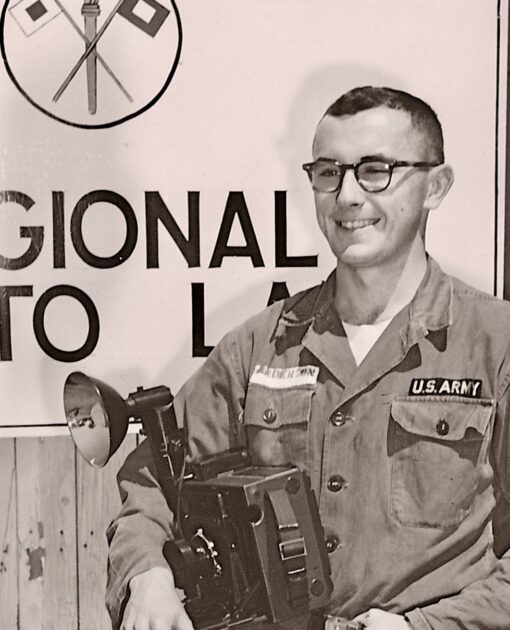
The next day I was called to the telephone at the Photo Lab. I was told it was from the Adjutant General’s Office, the army’s legal establishment. With a chill of apprehension I picked up the receiver in the reception area. The caller identified himself as a secretary in that office. “You’re up on charges,” he said. ”What have you been up to?” Lt. Redneck was not around to overhear, and so I told him my story.
“What’s going to happen?” I asked.
“The charge sheet? I’ve put it in the waste-basket.”
I was delighted and flabbergasted. “How can you do that?”
“I’m getting out next week. I’ll be long gone. But if I were you I’d get my ass out of there pronto!”
And he was gone, this man I never met but who was a member of my tribe, before I could finish thanking him. The next day I went down to the Personnel section. Fortunately the friendly sergeant was still there. I told him I did not want to spend the final nine months of my military career in the stockade and leave with a dishonourable discharge.
“Can you type?” he asked.
I had spent my sixteenth summer teaching myself. “I can do 60 words a minute. ”
He pushed his typewriter around to me and I demonstrated. He nodded. “There’s a vacancy coming up for a company clerk next week”.
“I don’t think I’ll last that long.”
“Okay, I’ll get you something temporary in the meantime.” He picked up the phone and the next day I reported for work at a warehouse off-base.
The warehouse was staffed by three or four middle-aged civilians who spent the day drinking instant coffee, clustered around a free-standing log stove pumping out heat in a small office. When the phone rang I would be sent out into the huge ice-cold warehouse and up a ladder to fetch something from the tiers of platforms. The warehouse operated on the FIFO protocol, First In First Out. Which meant that the oldest stock was always at the back of the shelves, so that I had to remove all the later items to retrieve it. And then replace them. On top of which there seemed to be an informal policy of putting the bulkiest and heaviest items on the highest shelves. I spent most of my time lurking on the fringes of the warm circle of good old boys swapping yarns around the stove, trying not to be noticed and hoping the sergeant in Personnel had not abandoned me. Nine months of this would destroy the will to live.
But after a week the phone rang and it was for me. The next day I was an MP, a military policeman.
Master Sergeant McGinnis, a gruff, burly man of Irish descent, had seen combat in Europe and lingered there as a member of the occupation forces in the American sector of Vienna. He and I sat in a little office at the back end of the Day Room, a recreation facility which the men in the military police company were forbidden to enter during the daytime. My job was to prepare the daily Morning Report, which recorded the current disposition of the members of the company. For instance, we ran the stockade, and the report would note whether an individual was on duty as a stockade guard or had now become a prisoner inside it. (As the military policemen tended to be a rowdy and pugnacious lot this occurred surprisingly often.) This routine involved filling in data on a printed form with three copies – an exacting task fussing with layers of carbon paper. My speed typing skills were redundant.
At 9.00am the Morning Report would be submitted to the commander of the MP company, Captain Hudson – the only black officer I ever encountered in my army career – who would come in to sign it. He might then shuffle through papers for a while or make a phone call or two. Within half an hour he would rise from his desk and announce to M/Sgt McGinnis, “I will be in the area all day.” Somehow McGinnis seemed to intuit whether this meant the captain could be located at the golf course or had gone shopping with his wife. We would both stand to attention and render stiff salutes and Captain Hudson would take his leave, usually not to be seen again for 23 hours. We would then both repair to the Day Room, McGinnis would peel the cover off the pool table and continue my patient daily instruction in the art of that game. This would continue, with a break for lunch, until close of business at 5.00pm, when the troops would be admitted to the Day Room and I could drive home.
“I told him I would try to shoot him in the legs rather than the back, but my aim wasn’t very good.”
One day M/Sgt McGinnis offered me a generous reward: a weekend visit to Los Angeles, all expenses paid. From time to time a young soldier would abscond from Fort Lewis, going AWOL (Absent Without Official Leave) . Inevitably it was because of girlfriend trouble. So the standard procedure was to contact the local police in his hometown and they would go and pick him up. The army then had to provide a guard to escort the deserter back to base. My assignment was a ‘prison chase’, to fetch a soldier held in the Los Angeles jail and deliver him to the stockade in Fort Lewis. This was a choice gig: you got time off-base, free travel and a per diem allowance. If you scrimped on your food and lodging you could put some cash in your pocket.
First, I had to report to the firing range to be checked out on a .45 calibre pistol. This weapon weighs well over a kilogram. You have to hold it with both hands with the arms fully extended, and it is impossible to keep it steady. So, you must raise it smoothly to fix on the target and squeeze the trigger in that still moment at the apex of the arc, before your arms descend. (Just the reverse of pressing the button on the Speed Graphic camera at the nadir of the arc when nose-diving a photographic target in a light aircraft.)
It is impossible to stroll with a heavy gun on your belt without a self-conscious hip-roll. Schlepping through downtown Los Angeles with a bulky holstered pistol and handcuffs dangling from my waist I felt all eyes upon me. The municipal jail was housed in a skyscraper that appeared to be the tallest building in the city. The prisoner begged me to take him out right away but our train would not leave until the next morning, so I refused. But what to do with the gun overnight? I asked the prison guards if I could leave it with them, but they refused. To save money I stayed in a YMCA for the night. I checked the gun into their safe, but removed the cartridges.
The next day I marched to the rail station handcuffed to the prisoner. Seated on the train, he asked to be released from the handcuffs. He seemed withdrawn and inoffensive but he was bigger than I, and I refused. The scuttlebutt in the army was that if you let a prisoner escape you would have to serve out his sentence. As a concession I told him that if he did make a break for it I would try to shoot him in the legs rather than the back, but my aim wasn’t very good. In the event, the only difficulty that arose was going to the toilet: I had to stand in the corridor with our wrists linked through the open door, and vice-versa.
After 22 months in the army I had a lucky break. An early release programme was introduced: if you got a letter of acceptance from a university for further education, they would let you go. I signed up for a summer course in radio and television at Stanford University in Palo Alto, California. I was undecided whether I would actually attend. The scuttlebutt was confused. Some said that you didn’t actually have to turn up for your studies, others that if you did not you would be retrieved and serve out the remainder of your term in the stockade.
In any event we would have to drive back to the east coast with an infant daughter, and to save money we planned to camp out along the way. I needed a two-man pup tent. I had done a favour or two for the supply sergeant and so I had a word with
him. He didn’t have any tents in stock, he said, but leave it with him.
On the day of my discharge, the 15th of June, 1956, I drove our red Plymouth convertible on to the base for the last time. The supply sergeant furtively heaved out a large bundle of canvas and ropes.
“You can use it like lean-to,” he said. “Stretch it down from the roof of the car.”
I wrestled it into the car. “But what is it?”
“A corner of a mess tent.”
A mess tent is designed to shelter a hundred or so men. And so, in due course, somewhere in South Korea these men would be huddling over their chow with a brisk wind whipping through a corner of their tent. There was a very popular situation comedy about chicanery in the U.S. military on television at this time, The Phil Silvers Show (Sergeant Bilko), broadcast from 1955 to 1959. Historians should regard it as a documentary.
But another of Aukamp’s war stories is the best. During his time as a conscript he found himself spending several weeks as one of two guards living in a caboose attached to the end of a lengthy railway freight train comprised of hoppers carrying bulk materials covered with tarpaulins. This train criss-crossed the vast open spaces of the continent, shuddering to a halt now and then for hours or days at a time, while hoppers were added or detached. Often, he had no idea where he was. But it was a soft gig, occasionally visiting a bar in some nameless backwater town; otherwise, idling the days away.
It was many years after his military service that Aukamp discovered what the U.S. government was transporting around the country’s rail network during the 1950s: nuclear fuel waste. This story is not drawn from my own experience, but second-hand, so I can´t vouch for it. But Aukamp was not a man disposed to footloose imaginings, and so I fully accept his account. Nevertheless, despite potential radioactive exposure, he lived on into his nineties.
Life Lessons
I never regretted my 22-month compulsory service in the U.S. Army. I learned a lot:
- Humility. Some former colleagues might snort at this. But it is humbling to be ordered about, cursed at and oppressed by someone who has probably never worn shoes before joining the army. Yet, you can learn from him because he comes from a different background; he has some knowledge, some intuition, you´re not familiar with. You realise you can learn from everybody. So, you listen and this leads to advantage.
- Protocols are not rules, they’re just guidelines. It is beyond the wit of man to invent a system which can anticipate all eventualities, judge outcomes fairly and not be open to wilful misinterpretation. Because the devil resides in the detail. Rules are to be evaluated and applied with insight and compassion. A squirt of empathy is the lubricant which makes the wheels of social justice grind true. As a natural rebel to blind authority I was gratified by this insight. And it is the crucial concern about the application of artificial intelligence to human interaction.
- Institutions do not prize performance, but rather the appearance of performance.
- People who survive an oppressive experience together form a strong bond: the “band of brothers”.
- Most people you meet are basically well disposed and their default position is to help you out. However be prepared to encounter the occasional psychopath who radiates deep-seated instinctive hostility.
- How to play pool. For an adroit shot you put some spin on the cue ball. You do not strike it dead centre, but slightly to the left or right. When the cue ball collides it imparts that spin to the target ball, which goes off at an angle. I realised then why I was so poor at basketball. If you throw the ball straight at the backboard, or with an instinctive backspin as it leaves your hands, it bounces straight back. A savvy player will give the ball a top spin, so when it hits the backboard it will duck down into the net. Why don’t they tell you these things?[ii] A little spin is useful in life situations, too. The way you say something can deflect the result, nudging someone in the desired direction. In politics, they even call it spin now.
[i] I once asked a professional soldier, a marine, but an apparently reasonable man, whether he would fight, say, British troops if ordered to do so. He thought this a stupid question. Of course he would. He would shoot and kill anyone he was pointed at. So if you think Donald Trump could not possibly . . .
[ii] They do now. I just looked it up on YouTube. I was born too soon.